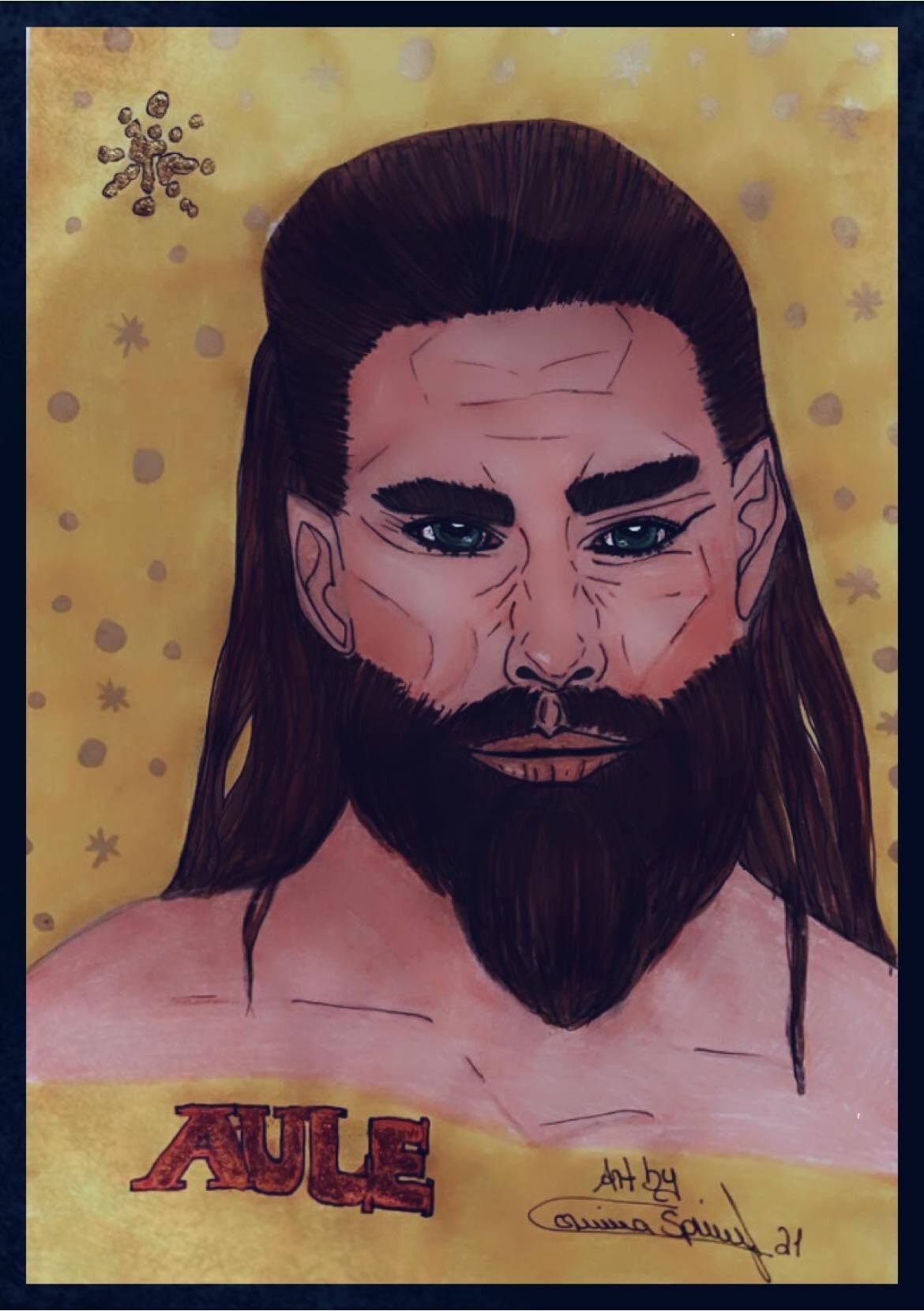
Aule Tolkien
As Aulë was a smith, he was the Vala most similar in thought and powers to Melkor, as both gloried in fashioning artistic and original things, and came to create beings of their own. But Aulë strove to be true to the original intent of the Music of the Ainur, and submitted all that he did to the will of Ilúvatar, while Melkor wished to control and subvert all things, and would try to twist or destroy others’ creations because of his jealousy. There was long strife between Aulë and Melkor both before and after the creation of Arda, though Aulë traditionally opposed attempts to fight Melkor, for fear of the damage that would be wrought to Arda.
🌟🌟🌟🌟🌟🌟🌟🌟
When the Elves came to Valinor, the Ñoldor became the students of Aulë. Fëanor was his greatest pupil, and from him learned to make gems through craftsmanship that was later forgotten. This would eventually lead to the Silmarils, the greatest creation of handiwork within Arda. On the Flight of the Noldor, the Noldor who returned to Valinor under Finarfin named themselves the Aulendur, Followers of Aulë. Despite his lordly skill, Aulë was humble and compassionate, and indeed the Dwarves survived only because Aulë submitted them to the will of Ilúvatar. His spouse was Yavanna, with whom he dwelt in central Valinor.
🌟🌟🌟🌟🌟🌟🌟
Desperate for pupils onto whom he could pass his knowledge, and unwilling to wait for the emergence of the Children of Ilúvatar, Aulë created his own race of beings, the dwarves. However, he did not have a clear idea of what the Children of Ilúvatar would be like, and because of the presence of the chaos caused by Melkor, Aulë made the Dwarves strong and unyielding, and not willing to endure the domination of others, as well as embodying some of his values and desires for Middle-earth. However, Aulë did not have the power to give independent life to his creations; they could act only when he thought of them.
🌟🌟🌟🌟🌟🌟🌟
When Aulë completed his work he began to instruct the Dwarves in a language he had made for them, Khuzdul. Then Ilúvatar spoke to Aulë, asking why he would seek to exceed his power and authority by attempting to make new life. Aulë repented, answering that the drive to create was kindled in him by Ilúvatar, and that he only wished for other beings to love and teach, with whom to share the beauty of the world. He admitted that his impatience had driven him to folly and submitted his creations to Ilúvatar’s will. Assuming that they should be destroyed, he made to smite the seven Fathers of the Dwarves with a great hammer. As he raised the hammer the Dwarves shrank from the coming blow, but Ilúvatar stayed Aulë's hand and showed that he had accepted Aulë's creations, and given the Dwarves spirits of their own, else they could not have been afraid.
🌟🌟🌟🌟🌟🌟🌟🌟
Ilúvatar accepted the Dwarves as his adopted children, but, as it was ordained that the elves were to be the first-born race, Ilúvatar set the Dwarves to sleep until after the Awakening of the Elves. He told Aulë that while both races were his children, the Dwarves’ creation was outside the scope of the Music of the Ainur, and strife would arise between the Dwarves and the Elves in the future. The Dwarves believe that after they die their spirits move to halls that Aulë has set aside for them alone, and they will help to rebuild Arda after the Final Battle.
Art by me Middle earth Tolkien fantasy art by Corinna Springl